


The Problem Space
Paying for everyday items internationally is a high-friction experience. It means carrying cash, loading a prepaid forex card, or reaching for an international credit card that charges a high, and often hidden, markup on every tap. Underneath all three sits the same quiet tax: the constant mental math of converting a foreign price back into rupees just to know what is actually being spent.
UPI International removes the pre-trip scramble by routing the payment through rails the user already trusts, so paying a merchant in Paris works like paying one in Pune. PhonePe was the first fintech in India to enable cross-border UPI: you turn it on before you fly, then pay abroad the same way you pay at home.
Core User Journey
One scan, settled in the merchant's local currency. The flow stays the domestic flow (scan, enter the amount, authorise with the UPI PIN), so nothing new has to be learnt at the counter, in a foreign country, under time pressure.
Price transparency
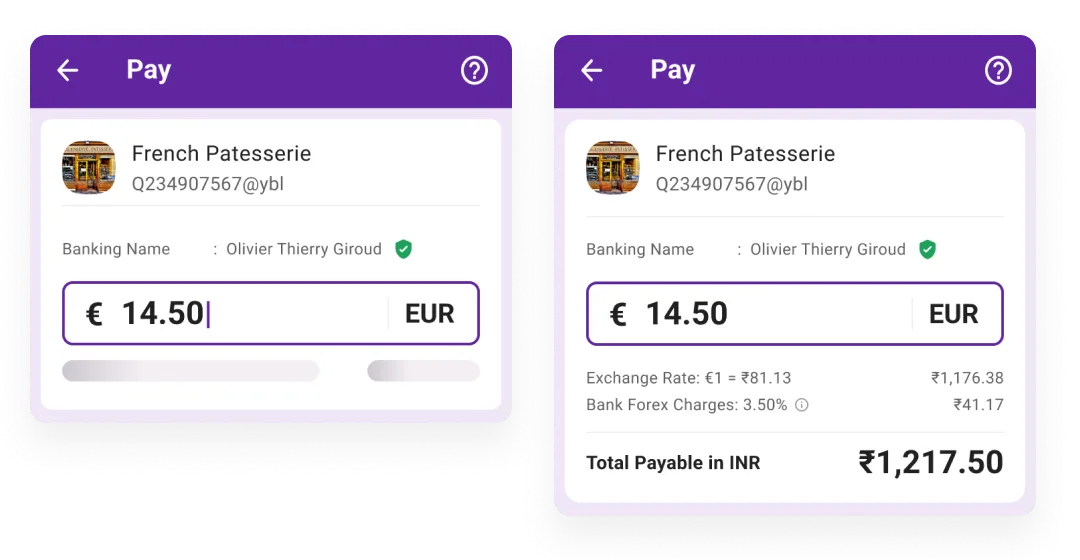
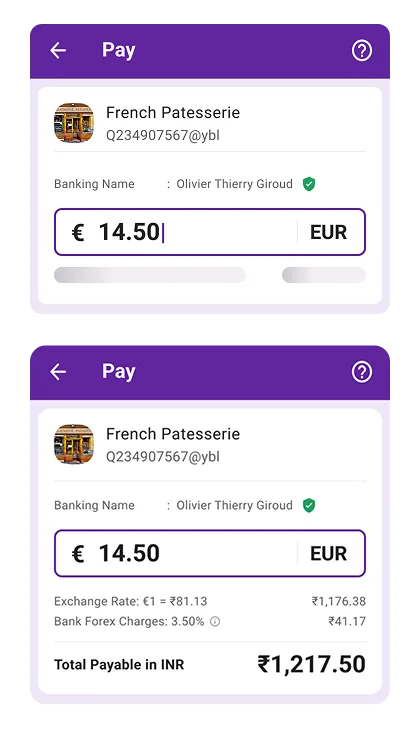
The conversion screen is the most critical interface decision in the international flow. When a user scans an international QR code, the merchant's system requests a specific amount in the local currency (AED, SGD), which is never the number the payer thinks in.
- Dual currency display: the payment screen leads with the foreign-currency amount, exactly as the merchant billed it.
- Live exchange rate: directly beneath it, the real-time rate and the exact rupee figure that will be debited from the bank account.
- Why this matters: the mental math disappears. Guaranteeing the final INR cost before the PIN screen is what establishes trust: it answers the fear of a hidden forex markup at the one moment that fear actually bites.
Activation
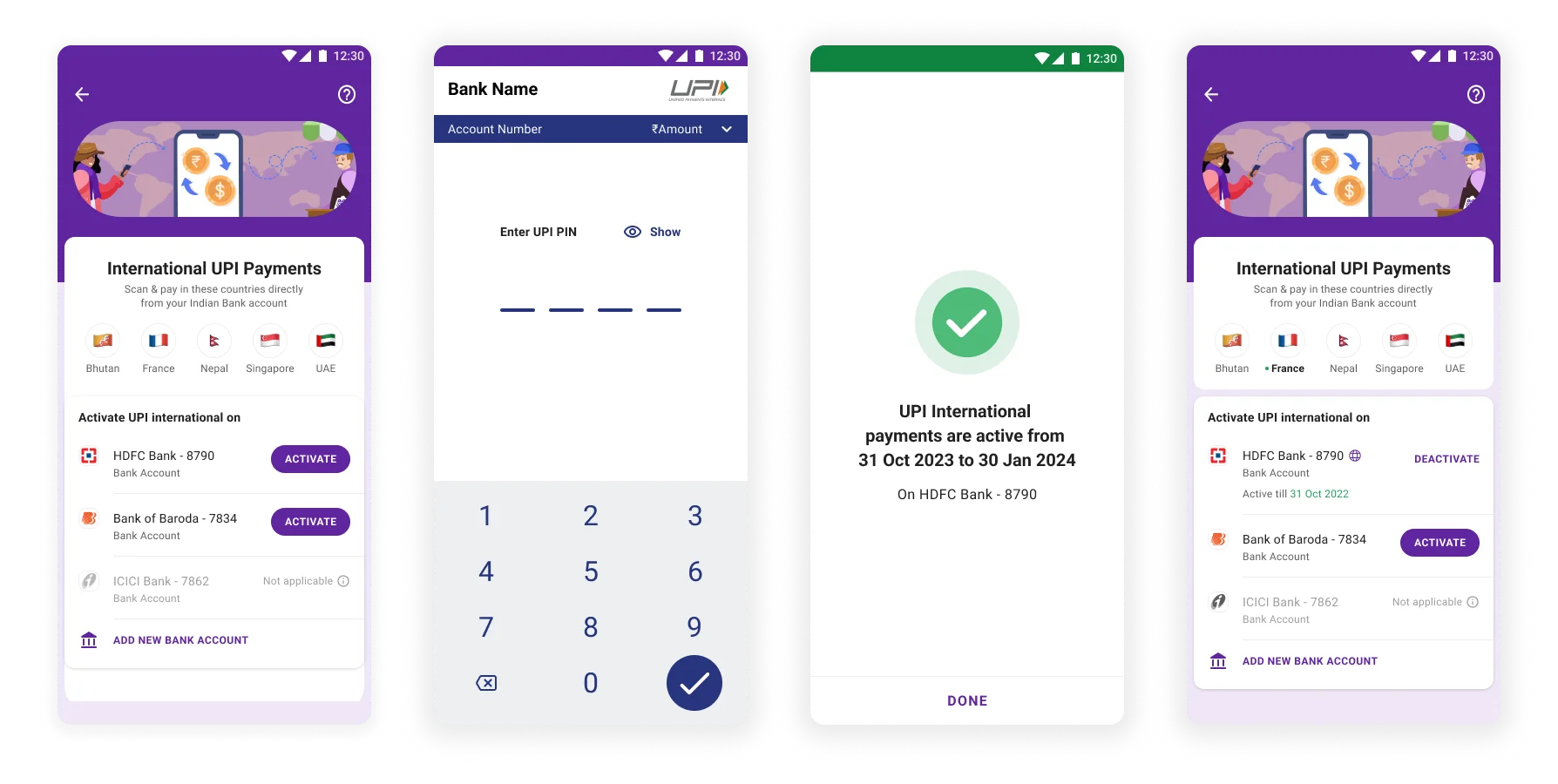
International payments over UPI require explicit user consent and bank authorisation before they will work at all: a fraud control, never a formality. The design problem is making a mandatory security step read as part of the journey instead of a detour into settings.
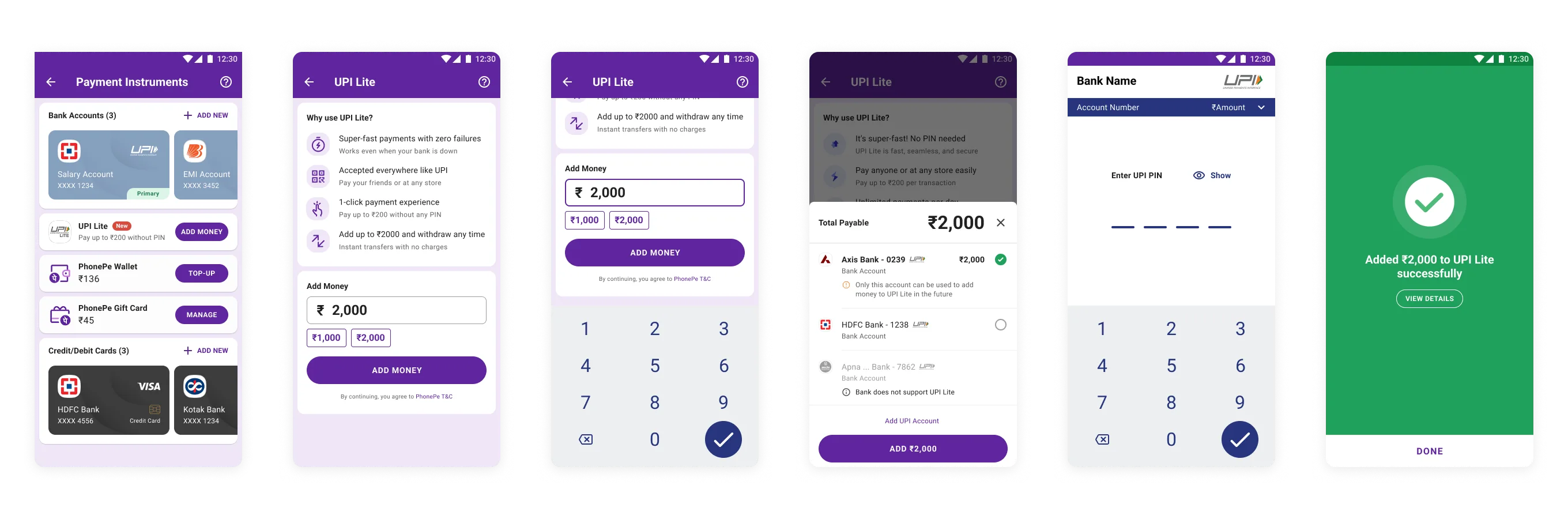
- Contextual prompting: rather than burying the feature in a settings menu, the activation prompt surfaces the first time a user scans a supported international QR code, or when the app detects a foreign network or location.
- One-tap activation: a single "Activate UPI International" call-to-action, authorised with the standard UPI PIN. No new credential, no new mental model.
- A validity period that expires by itself: activation holds for up to 90 days and then switches off automatically. Security that doesn't depend on a traveller remembering to turn it off once they're home.
Payment Settings carries the same switch for anyone who prefers to arrange it before flying. PhonePe adds no platform fee; the partner bank applies its usual foreign-exchange markup, and settlement issues abroad go to the issuing bank rather than PhonePe.
In the press
- PhonePe becomes India's first fintech to enable cross-border UPI payments · phonepe.com
- PhonePe launches UPI International for payments to foreign merchants · Hindustan Times
- The launch, announced on X · @PhonePe