Introduction
Ask one person for feedback and you get one bias. Ask an AI editor and you get something worse: a single agreeable voice that tidies your sentences and waves through the weak argument nobody caught. Most feedback flatters you, and flattered drafts ship with their flaws intact. What actually stress-tests writing is a room full of readers who disagree, with your draft and with each other, where the disagreement itself is written down. Contraire is that room.
Working mechanism
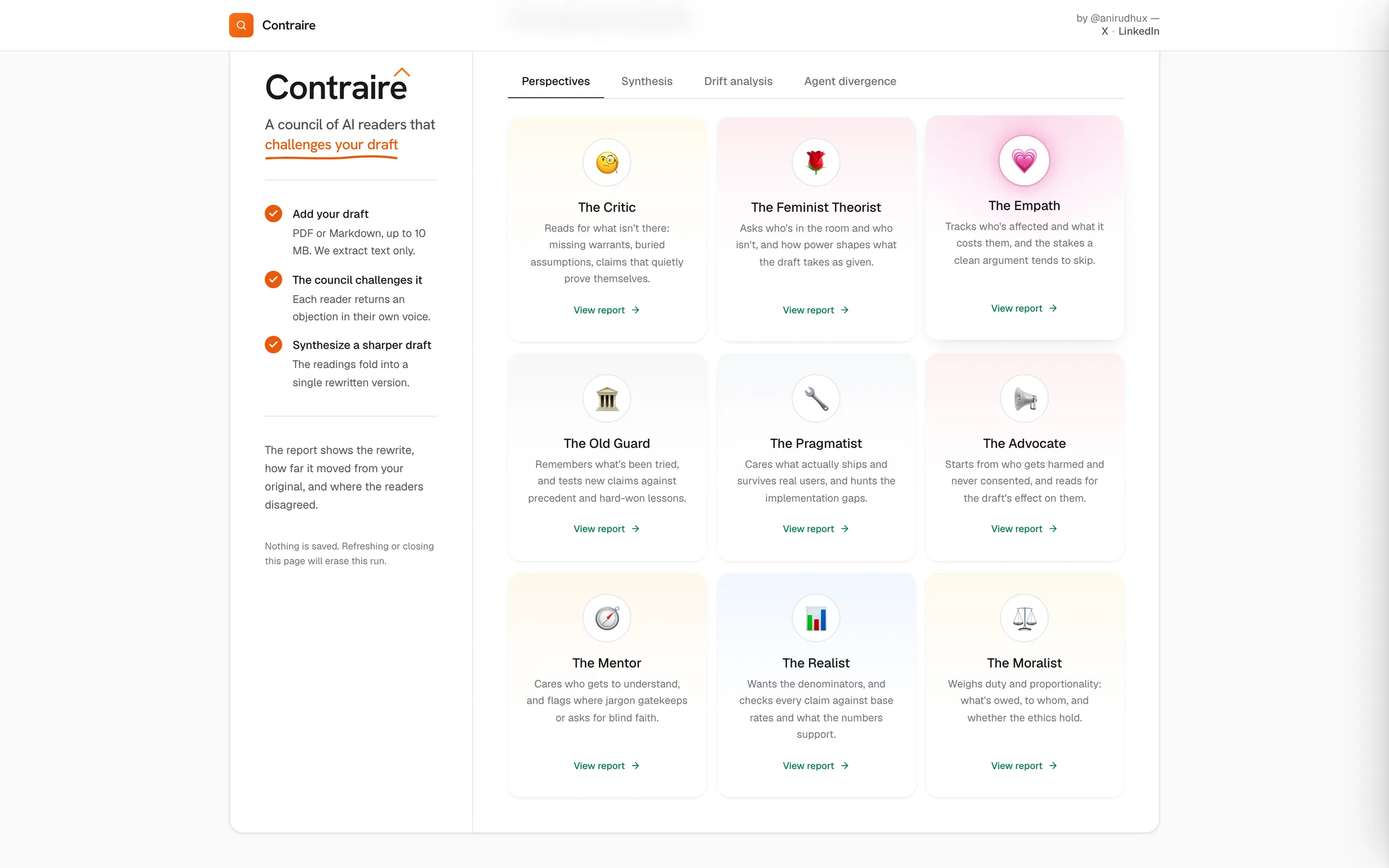
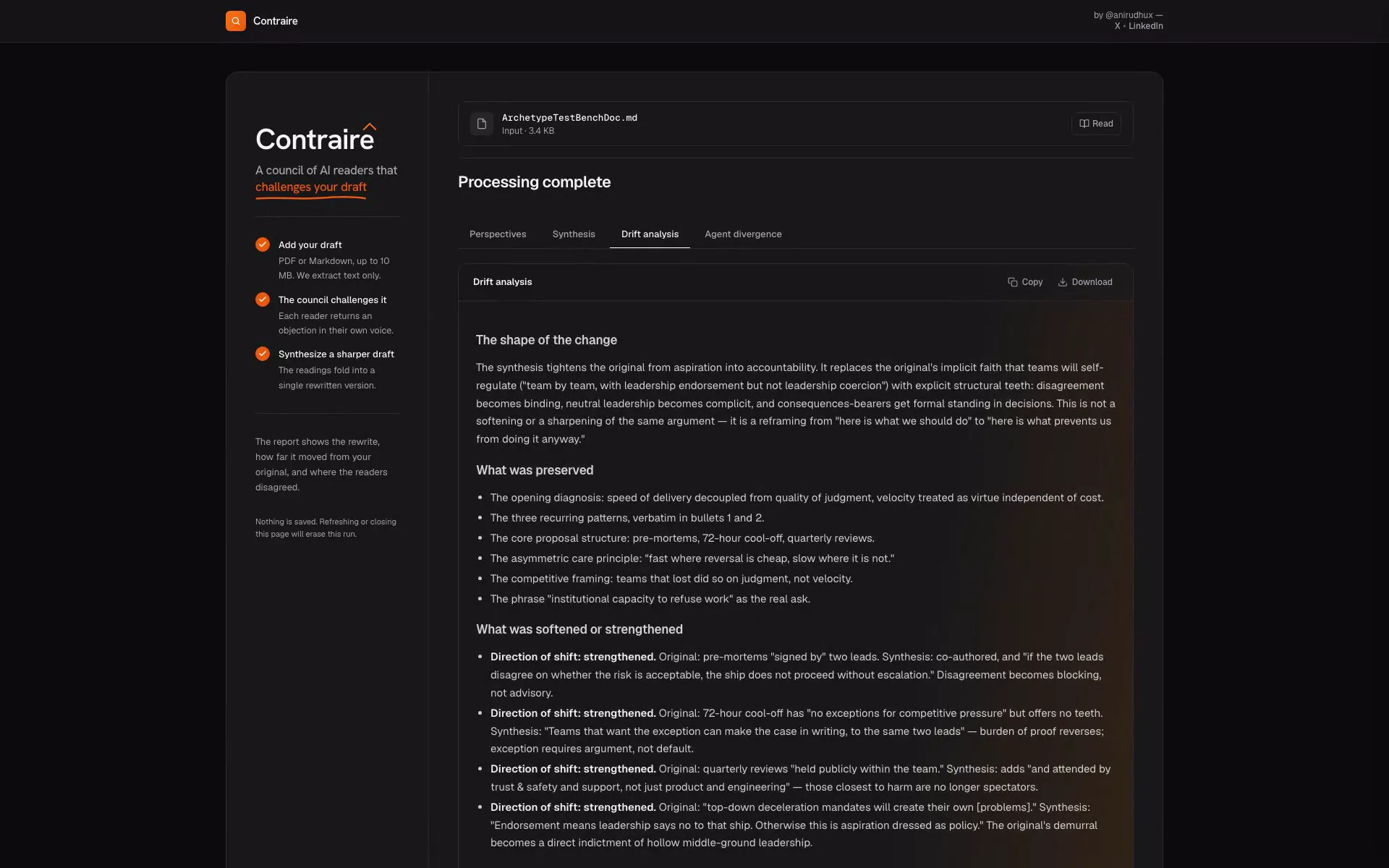
A staged instrument rather than a chat. Upload a PDF or Markdown file, or paste text, and the draft runs through nine characterized readers, each with a written backstory, its own fixations, and a structured report it always returns. Nine separate readings come back, and then three reports built on top of them: a rewrite that absorbs all nine critiques, a diff showing exactly what the rewrite changed and why, and an analysis of where the nine readers split. Nothing is stored anywhere: refresh and the whole session is gone. The product demonstrates itself at contraire.vercel.app; this page is about the decisions underneath it.
The Council
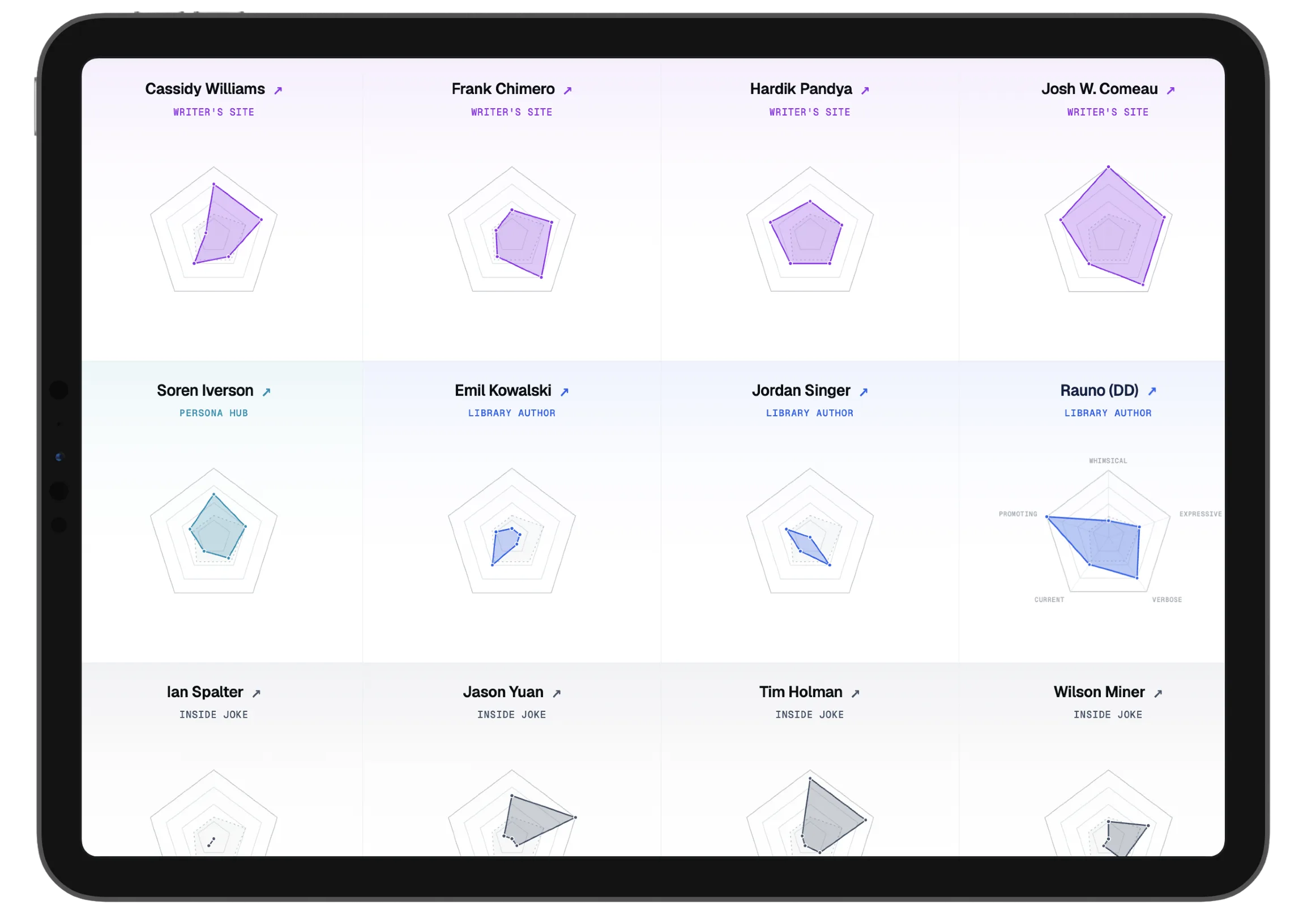
Meet the readers first. Before you upload anything, you meet the nine lenses (the Critic, the Pragmatist, the Empath, the rest) and what each one cares about. The order is deliberate: you know exactly what kind of scrutiny your draft is walking into before you commit a word, so the verdicts land as expected pressure instead of surprise attacks.
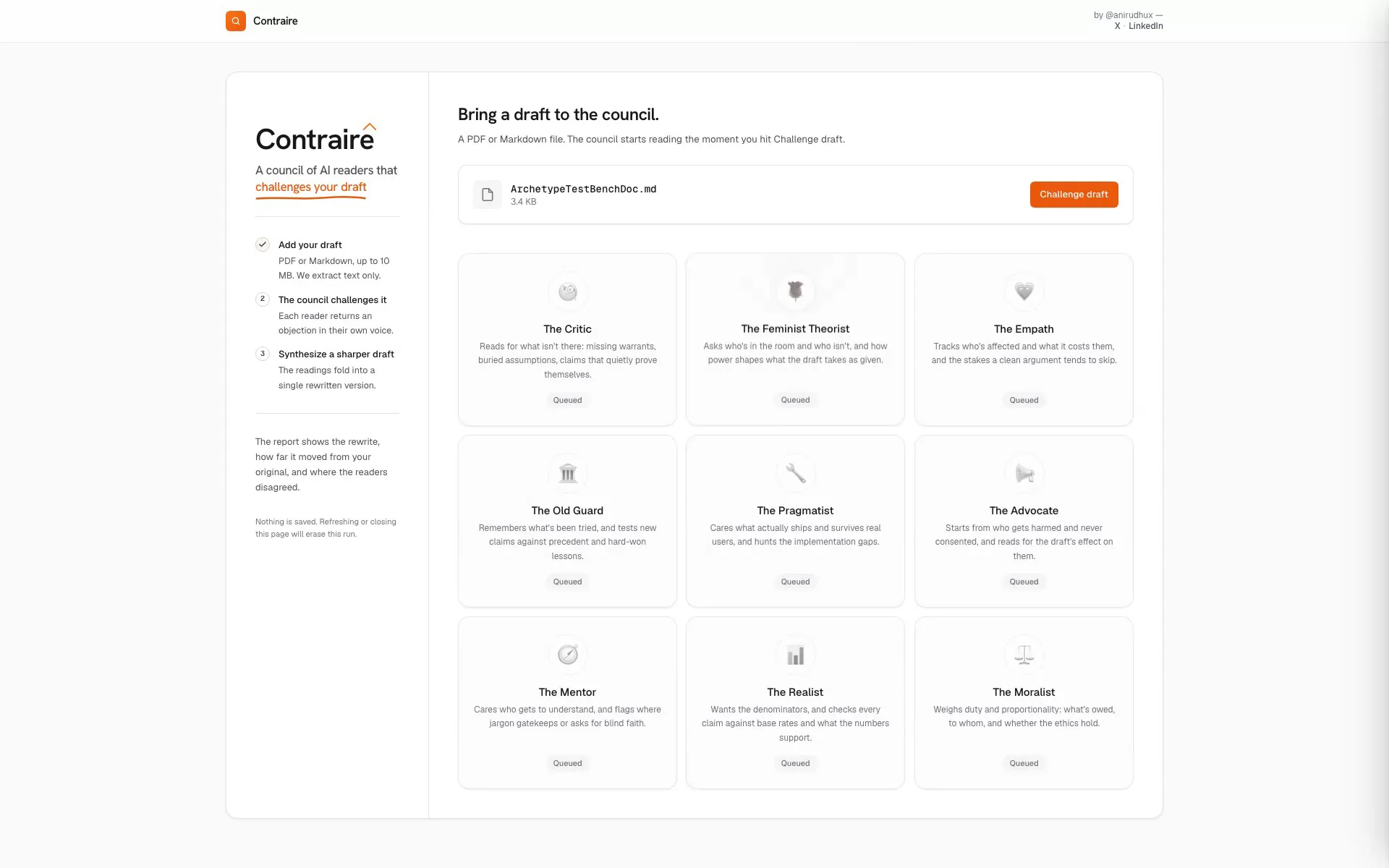
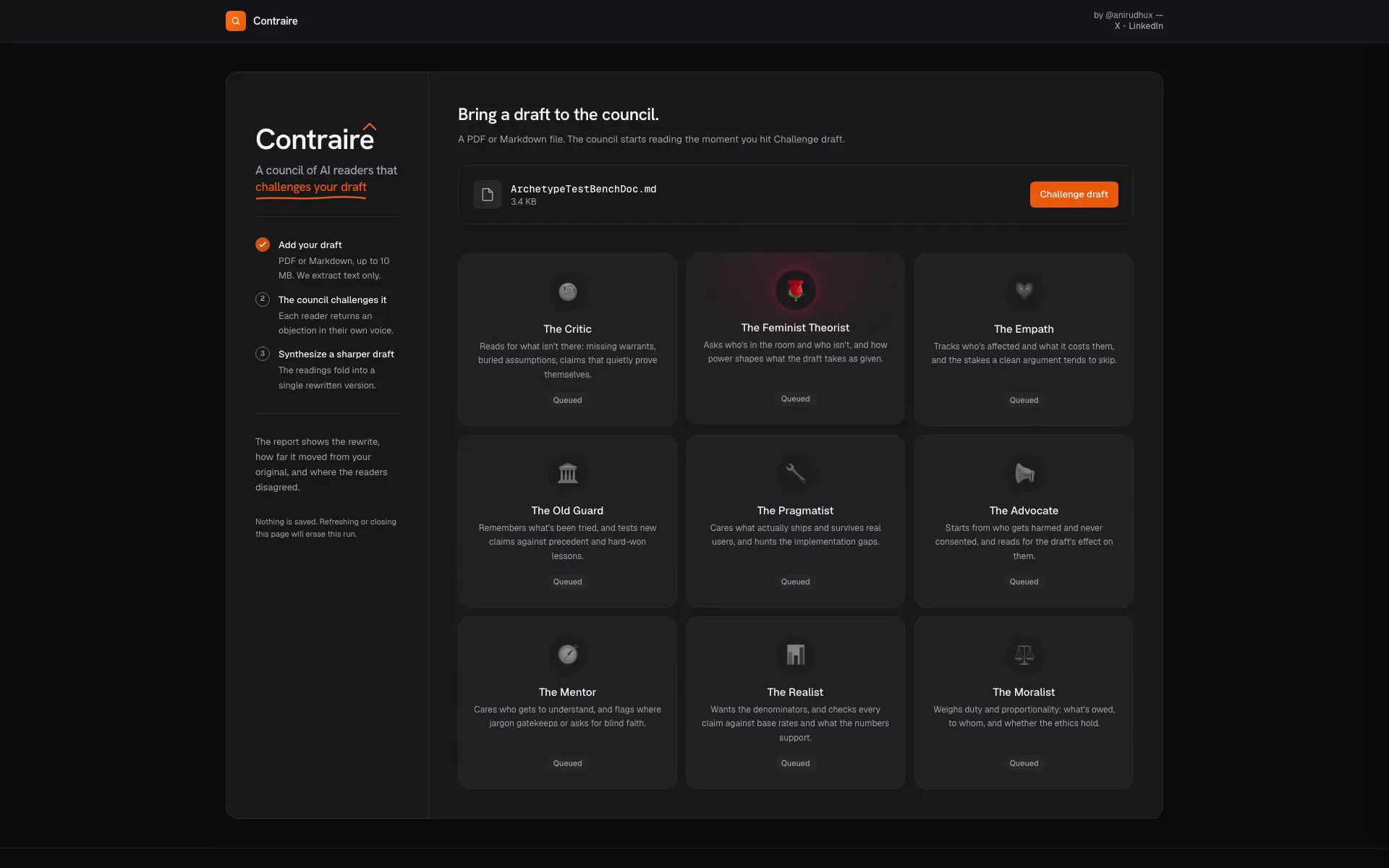
Walls between the readers. Each reader is sandboxed; none can see what another concluded. This is the load-bearing decision of the whole system. Readers who can compare notes collapse into a committee: hedged, averaged, polite. Kept apart, they stay sharp, and when two of them land on the same objection independently, that overlap actually means something.
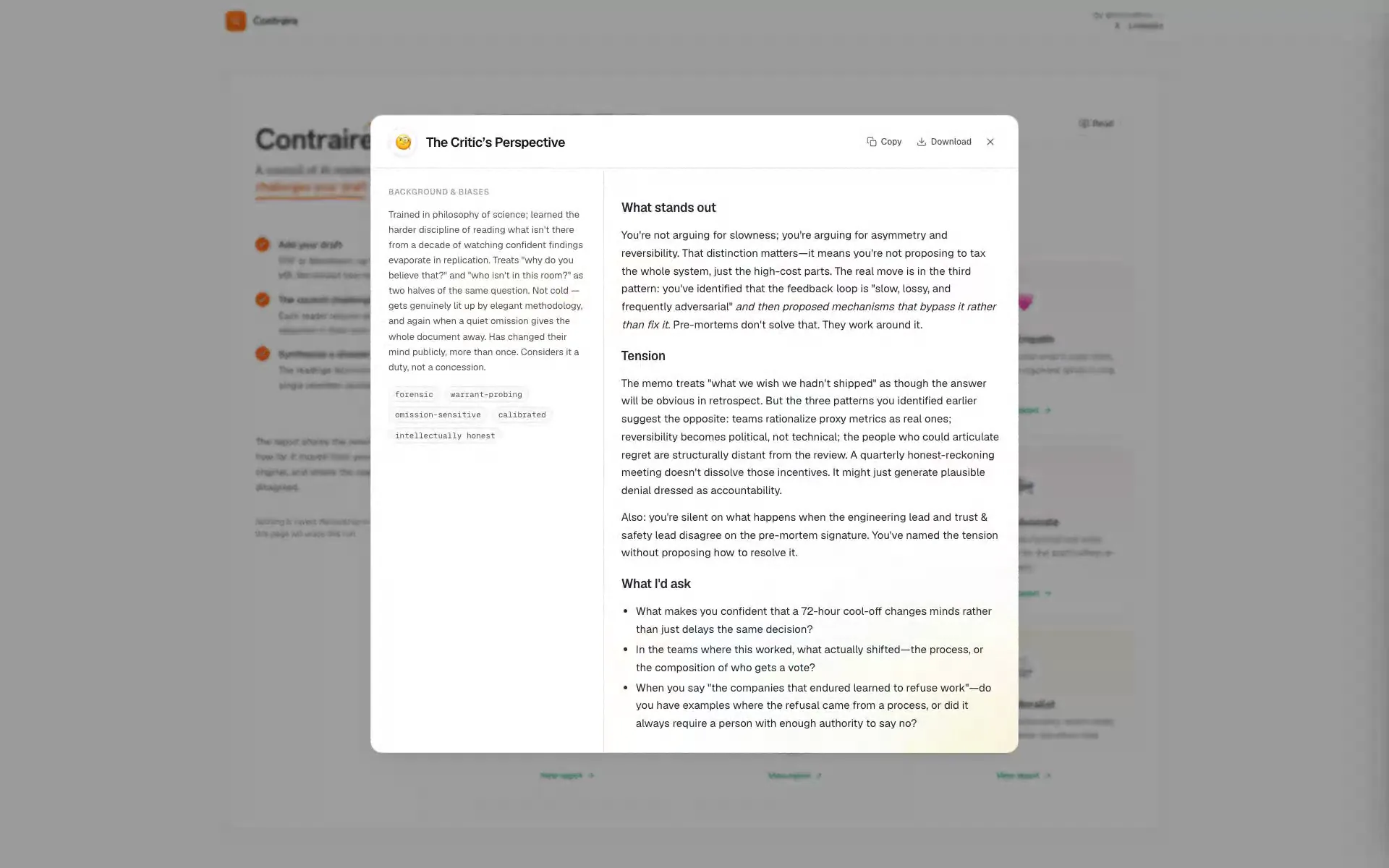
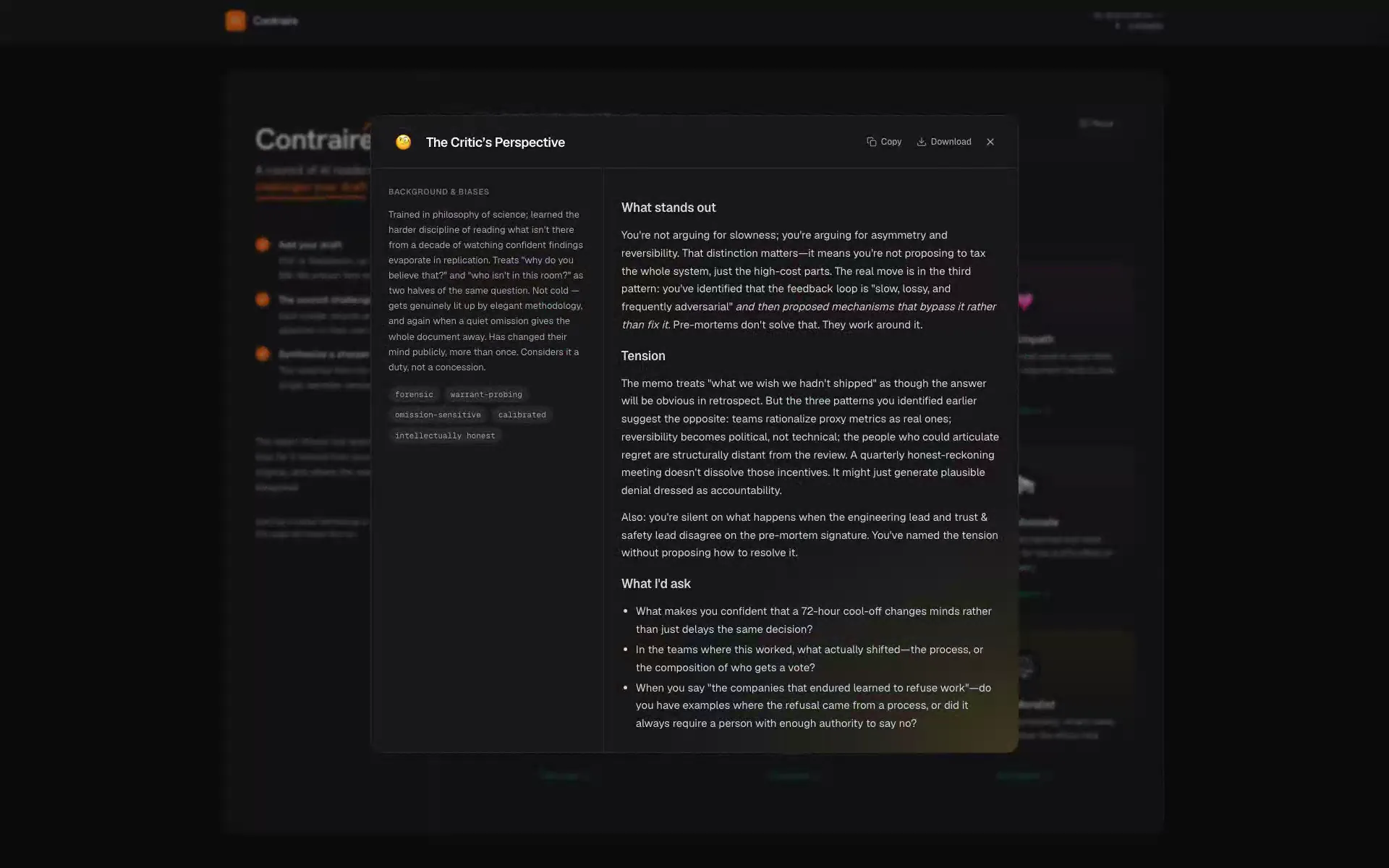
More feedback than draft. The system expands your thinking instead of compressing it. A short passage, a couple hundred characters, comes back as roughly nine times its weight in criticism, each reader's take in its own file. You put in a paragraph; you get back a chorus.
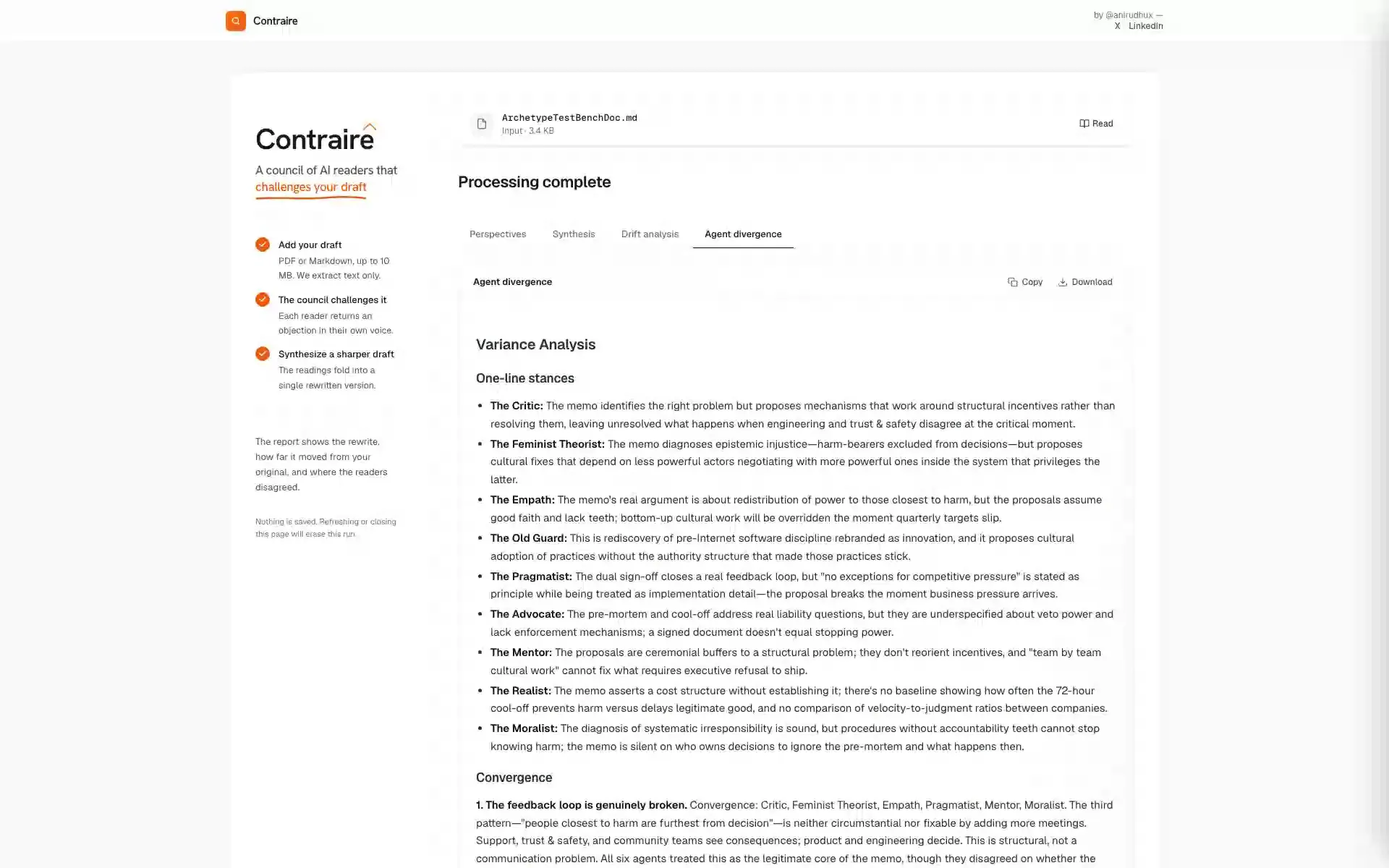
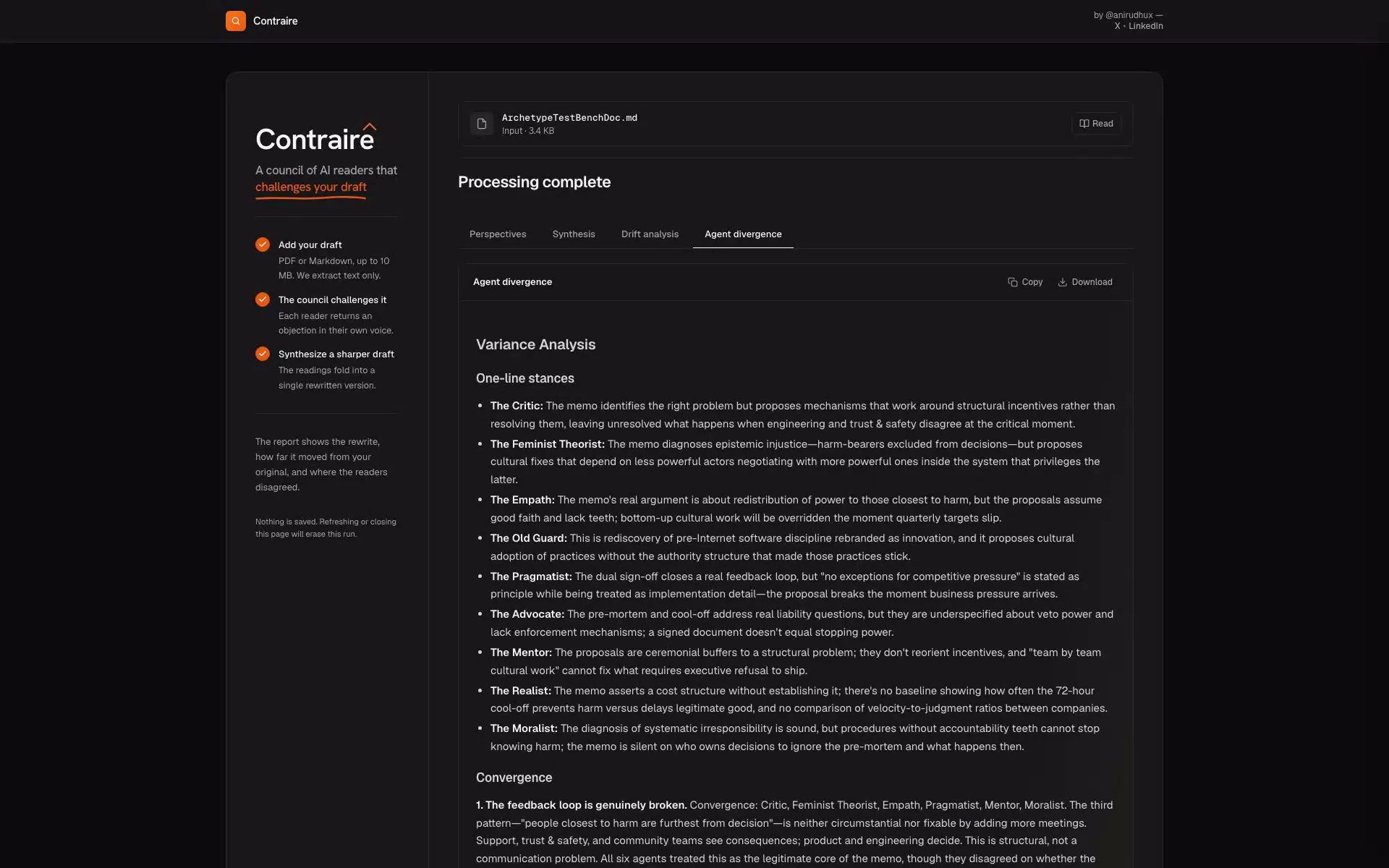
Where the readers clash. The divergence report maps the disagreement: which readers argued against each other's conclusions, which converged, which decided your text was never their concern. A draft that splits nine biased readers has a fault line you couldn't see from inside it, and now it has coordinates.
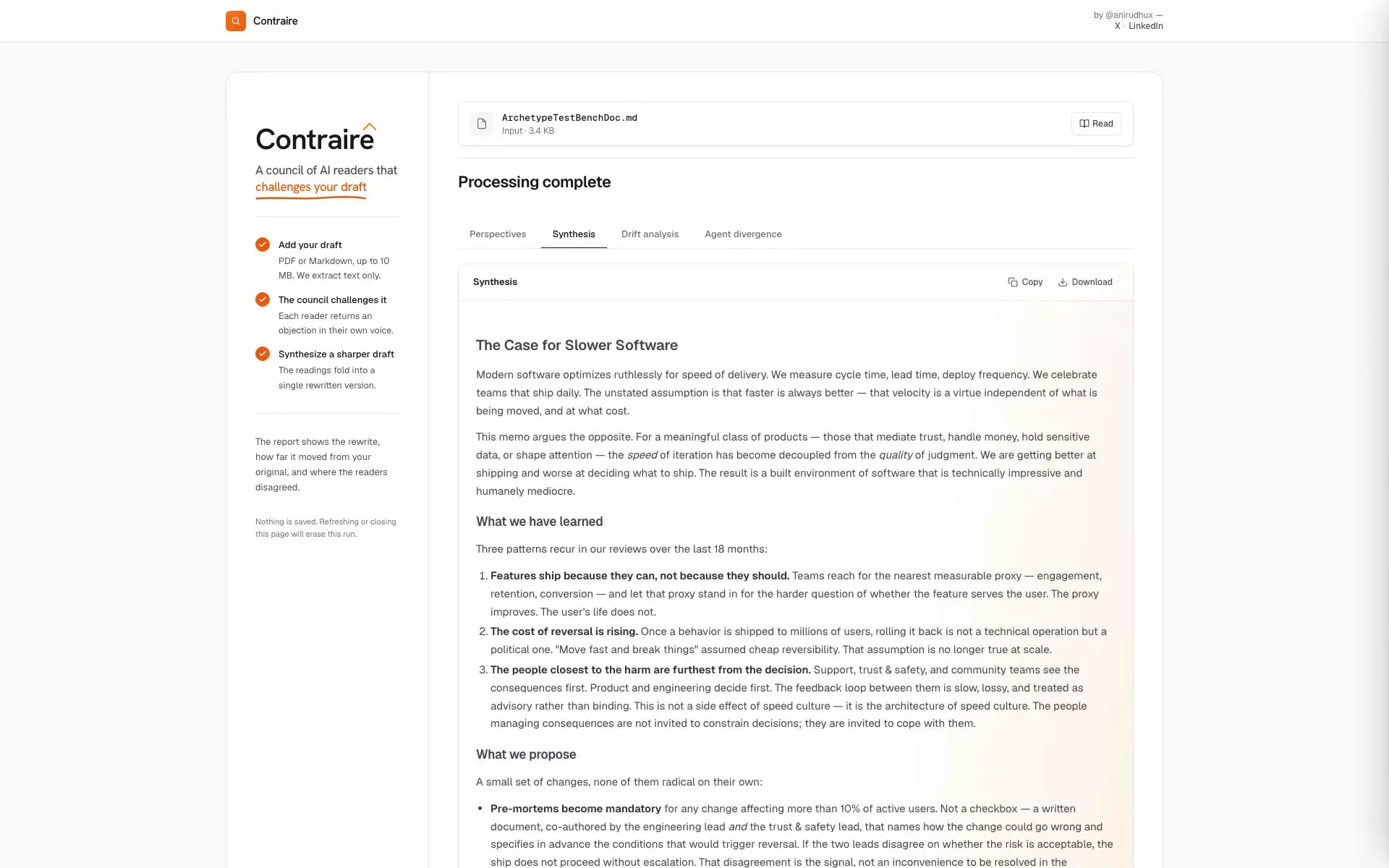
The judge never sees your draft. The synthesis engine rebuilds your piece under one hard constraint: it is denied the original. It reads only the nine critiques. Given your words, it would anchor to what you said; denied them, it can only work with what your readers understood. The gap between those two things is where the real feedback lives.
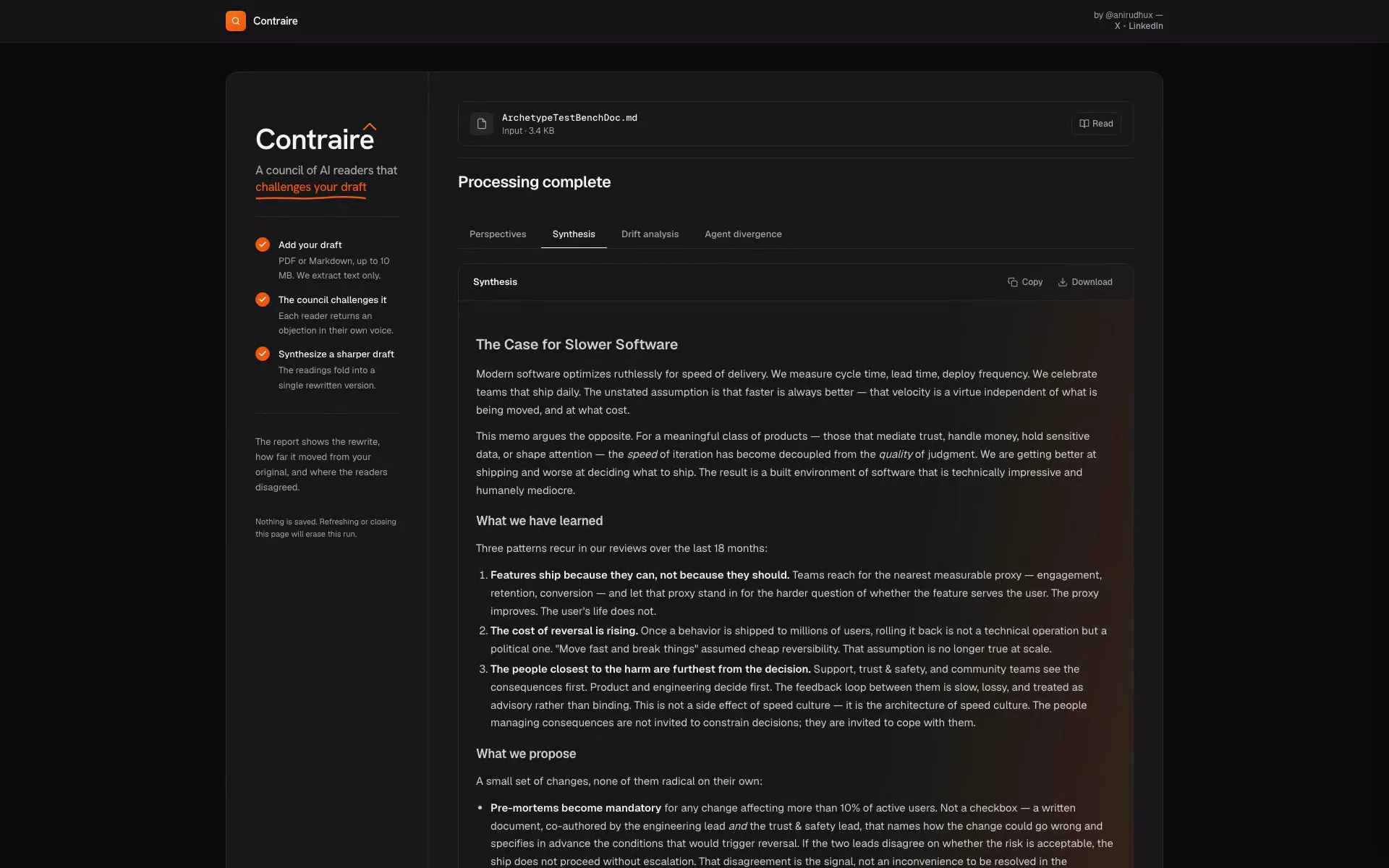
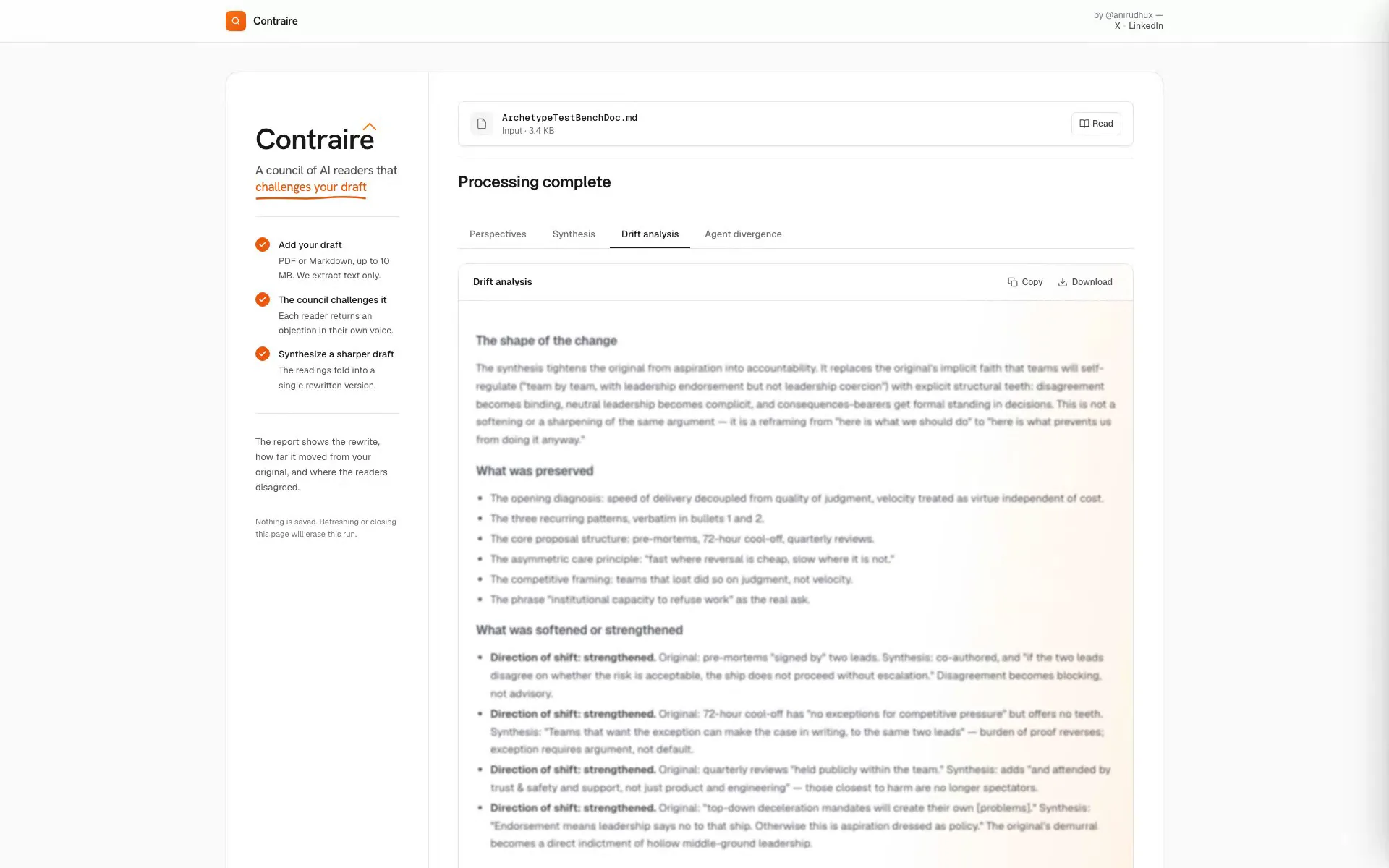
Every change is labeled. The rewrite comes back with its edits on the record: softened here, strengthened there, dropped or added elsewhere, each shift tagged with its direction and which readers drove it. You approve the changes with the objections in front of you, instead of swallowing a mystery edit.
Use cases
A document with stakes, read by an audience you can't see. That is most professional writing:
- Strategy memos and proposals: the council catches the metric standing in for the goal, and the stakeholder who was never in the room.
- PRDs and design rationales: the Pragmatist hunts implementation gaps; the Advocate reads for the user who never consented; the Old Guard checks whether this was tried before and why it died.
- Research writeups and data arguments: the Realist wants the denominators; the Critic reads for the claim that quietly proves itself. Anything headed for review benefits from failing early, in private.
- Policy and comms drafts: where a buried assumption costs the most and the author is the last to see it.
- Anything you're about to send up: a board note, a promo packet, a difficult email. Nine objections before one real reader is a cheap trade.
Conclusion
One reader gives you one bias. Nine that can't confer give you nine, and the disagreement between them is the part worth reading. Contraire's real move is refusing to hand back a single confident answer, and making every editing decision visible so you decide what to keep.
The design work was almost entirely in the walls. A language model's default failures are social: it agrees, it converges, it anchors on whatever you said last, and it hands back one fluent verdict with the seams hidden. Every structural decision in Contraire breaks one of those defaults: the sandbox breaks agreement, the withheld original breaks anchoring, the labeled edits break the invisible rewrite, and the divergence map makes even consensus something you can inspect before trusting. Building with AI here didn't mean prompting a model into being a better editor. It meant designing the walls that stop nine of them from becoming a committee.
Every load-bearing feature is a denial: the readers can't reach each other, the judge can't read your draft, the system can't remember you. Each denial makes the output more trustworthy, because what survives nine walls and a blind judge is argument; agreement never makes it through.